We can't find the internet
Attempting to reconnect
Something went wrong!
Attempting to reconnect
Theory of Man · 17.9K views · 437 likes
Analysis Summary
Performed authenticity
The deliberate construction of "realness" — confessional tone, casual filming, strategic vulnerability — designed to lower your guard. When someone appears unpolished and honest, you evaluate their claims less critically. The spontaneity is rehearsed.
Goffman's dramaturgy (1959); Audrezet et al. (2020) on performed authenticity
Worth Noting
Positive elements
- The video provides a practical, time-efficient alternative to high-volume training that may be highly motivating for middle-aged individuals struggling with gym consistency.
Be Aware
Cautionary elements
- The systematic dismissal of 'science-based' training as ivory-tower impracticality creates a false dichotomy between academic research and effective results.
Influence Dimensions
How are these scored?About this analysis
Knowing about these techniques makes them visible, not powerless. The ones that work best on you are the ones that match beliefs you already hold.
This analysis is a tool for your own thinking — what you do with it is up to you.
Related content covering similar topics.
Essentials: How to Build Strength, Muscle Size & Endurance | Dr. Andy Galpin
Andrew Huberman
How to Train for Longevity (Not Just Fitness)
RESPIRE
The "4 Training Pillars" Men Over 40 Need to Stay Strong
RESPIRE
The 3x5 Strength Protocol That Builds Power Without Fatigue
Theory of Man
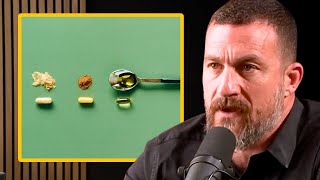
Andrew Huberman's Daily Longevity Stack (Even 10 Years Later)
Theory of Man
Transcript
If you [music] could give me 45 minutes twice a week, that's all [music] you need to do. You know, I hear this a lot now about this science-based training, but I actually don't know what science they're talking about. This is all very interesting, but if it doesn't work in practicality, what's it worth? [music] So, I've just got my posture really good. I've done yoga. I've done pilateses. Do some functional training. I don't have any pain, joint pain. So I know [music] that your your opinion on real world results versus um uh laboratory studies but these days let me just put something out there. I'd like to see your response. These days uh you know people will talk a lot about okay the studies or muscle biopsies show you train a muscle and stimulate uh hypertrophy growth and then muscle protein synthesis peaks you know 48 hours later which means that you can hit the muscle again ideally 3 days later or 2 days later. I tried that because I thought, hey, listen, I'm a scientist. I'll try it. And I immediately started going backwards with my progress. This was a few years ago. And um went back to training each thing directly once per week. And where there's indirect uh stuff, you know, arms getting hit once indirectly because of a chest and back workout on a separate day, found I went right back to to progress again. And so, you know, I'm a scientist trained to do science. So what how do you think about something where in a laboratory you can see something like protein synthesis peaks 48 hours later therefore train every 72 hours versus the real world phenomenon. This is all very interesting, but if it doesn't work in practicality, what's it worth? You know, I hear this a lot now about this science-based training. But I actually don't know what science they're talking about. I mean, some meta studies, I think, but how were those studies carried out, with whom, and so on and so on? I don't No, I know the case at study where he put on 65 pounds of muscle verified in a month by training like >> less than about an hour a week. I think >> those were whole body to failure and yes he was very underweight because he wasn't on anything and then he got sick. So >> he's underweight. So he's building back muscle but he wouldn't build it back without much stimulus. So 65 lb of muscle, although it was uh muscle memory, let's say, had been that big before, but he put it on >> in a month. And you compare that with Arnold that dieted down to 210, I think, to do this film, Stay Hungry. Then he went back up to 230 for the Mr. Olympia, but that took him like 3 months. So you [music] can compare the two. So when the people talk about these science-based studies and you shouldn't train to failure, it's better to keep reps in reserve. I don't know which studies they're talking about. I'm not saying they're not out there, but I'm not familiar with them. I'm not familiar with how they carried out the studies, but if it doesn't work in practicality, does it does it really matter? >> Well, often I I've spent some time with these and you might not be surprised to learn that a lot of times it's, you know, we got some college students, they're doing leg extensions, you know, we're looking at, you know, biopsies of the quadriceps, this kind of thing. Rarely is it the kind of compound movements, multi- joint movements. Um, sometimes, but but not always. Well, I look, my experience with the hit, highintensity, lowish volume training has been I'll say it's not just about gaining muscle. I mean, I'm now 50. I know you're almost 64. Yep. >> Looking looking [clears throat] amazing. Um, we'll tell us more about longevity stuff in a in a bit, [music] but I have to say part of it is also that if one trains the way that you're describing [music] each muscle once per week, focusing on intensity, not volume, and so forth, 6 weeks or so, then backing off for two weeks. >> You also find that in your peer in your peer [music] group, you're not the one complaining about pain. And you have energy for other things, [music] which we'll get back to. I mean, unless you're a competitive bodybuilder, I most people, including myself, need energy to tend to life and want to be able to enjoy not be. It's not the soreness, it's the constant aches and pains that come from overtraining. I think that most people uh don't have to live with, but think they do. >> It depends on your goals. Yeah. >> But I really believe the average person Yeah. that wants to get health benefits from bodybuilding, weight training, resistance, whatever you want to call it, right? they they have a guy that's 40 or 50 or 60, guy or a lady, whatever. The idea is if you could because you've lost muscle mass slowly since maybe 1% a year since you're 40, right? And this is affecting your health, your metabolism, your ability to process sugar, many many things. Yeah. Uh [music] bone strength. And the number one thing that I hear from people is I don't really have time for that. I have a business. I have a family. I said, "Right, if you could give me 45 minutes twice a week, that's all you need to do." Okay, you need to eat properly and and everything like that, but that's all you need to do for the average person. If you took eight to 10 exercises that covered your whole body and you did it twice a week, that would be enough for the average person. One for chest, one or two for back, one or two for legs. Hey, if you want to do some bicep curls and some triceps, you can do it, but you're doing pressing anyway. So, for the average person, that would actually be enough. And it's not theory because I've done it with people. Like I'm saying, this gentleman that came along, we put 45 minutes in uh nearly an hour three times a week cuz I had him doing cardio as well. >> Mhm. >> Well, guess how long the cardio was? >> 6 minutes. [music] 6 minutes. >> You mean pedal hard? >> We're doing We're doing in um sprints. >> Mhm. like on an air bike. It's my favorite because it engages every muscle. Push, pull, [music] legs. >> If you do a 20 second all out and you can see how you got on the side of the thing, you can see how much watts you're generating. So now you have a target to hit or exceed every time. >> So do a minute, minute and a half warm up, whatever. Feel warm. All out. Balls out like the devil's chasing you for 20 seconds. First one's tough, but it's okay. Go down slowly for a minute. Do the second one all out. Second one's really tough. Yeah. The third one is I've never met anybody that wants to do one after the third one because literally you can't breathe. Um and the benefits from that again I think there's a book called the one minute cardio. It's a bit [music] tricky cuz it's not really one minute. It's one minute of sprints >> but it's 6 minutes in total. And they compared that to 45 minutes of steady cardio on a treadmill or whatever it is. and the results are more or less the same. >> So, what do you want to do? You want to spend 6 minutes or you want to spend 45 minutes? I rather do the 6 minutes. Um, I do a bit of long cardio as well myself cuz I like biking in the mountains and stuff. But if you did that twice a week along with some weight training, that would be amazing. You change your life literally with that and a good diet. So, the whole time thing excuses, it's not relevant. I'm not listening. You don't need a lot of time. >> You look lean and strong. Yeah, I'm I'm lean. I'm strong. I don't uh push too much with the weights. Uh >> and you kept your height. You know, a lot of people who don't train >> interesting, man. I didn't keep my height. >> Really? >> I got taller. >> No, I saw that I posted uh about a month ago, six weeks on my page, just teasing people. >> Uhhuh. >> Because I went to get some orthotics in my shoes, you know, >> to balance uh out. >> And uh the guy's got the measuring thing. So, I just stood on said, "You're 183." Like 18. I've never been more than 180. system folks. Yeah. Right. It's like 6 foot, right? I was 10 510 and a half, 5'11, maybe. >> So, did I physically grow bone? No. >> That's what I thought cuz I'm 6 6'1. I heard you're 5'10". Walked in thinking maybe people usually lose a little bit of height unless they train real hard and they make sure to take great care of themselves and then I walk in and you Yeah. You're about 6 feet. >> Yeah. But the thing is why? Because I've been doing Pilates and functional training and resetting the shoulders back, my posture is much better. >> So, I'm standing straighter, which gives me an extra inch of height. So, I've actually got taller. No, I haven't taken huge amounts of growth hormone and suddenly grew when I was 60 years old. Is just my posture and the way I stand. There's less curvatures, shoulder there. So you lose a bit of height because when you lift and your pecs get bigger and your lats, your shoulders rotate forward. You're trying to hunch forward. So you're sitting a little bit lower. I didn't even know. I was like measure myself like, "Wow, that's just because I'm standing straighter and my shoulders are back. The less that cervical arch, it's more is straighter now." And >> what we call the text neck for the kids >> forward, shoulders forward. You know, a lot boxers have it because they're always like forward with their shoulders. So, I've just got my posture really good. I've done yoga for like €7. I've done Pilates. Do some functional training. [music] So, it's all about getting this thing in to the best shape. I don't have any pain, joint pains. I'd hip replacement like 14 months ago, which is
Video description
In this conversation, Dorian and Andrew explore the gap between scientific studies and real life practical results. For men balancing business, family, and long-term health, the idea that you need endless hours in the gym simply doesn’t hold up. Two focused strength sessions per week, covering the entire body, combined with brief high-intensity sprint work, can deliver powerful metabolic and muscular benefits without draining your energy for life outside the gym. This episode challenges the obsession with frequency and volume, and instead makes the case for intensity, recovery, and practicality. If the goal is longevity, strength after 40, and sustainable performance, sometimes training less is exactly what produces more. We break down why lower frequency, higher intensity training can outperform high-volume programs, especially for men over 40. Training each muscle once per week directly, combined with indirect stimulus from compound movements, often leads to better recovery, fewer chronic aches, and more sustainable strength gains. The discussion also covers why many “science-based” studies rely on simplified movements like leg extensions rather than real compound lifts, and how that can distort expectations. Join #1 men’s community for strength, fitness & longevity. Ask questions, share knowledge, and get support to stay strong for life https://www.skool.com/theory-of-man-5968 Subscribe for more practical, science-backed tips to improve your health and well-being: https://www.youtube.com/@UCgT9oGaVMnQovXUCLPMJu_A Podcast Host: Andrew Huberman YouTube: @HubermanLab Fair Use Disclaimer 1. Under Section 107 of the U.S. Copyright Act, allowance is made for fair use for purposes such as commentary, criticism, education, research, news reporting, and analysis. Fair use is a use permitted by copyright law that might otherwise be infringing. 2. This channel does not claim ownership of all content used. Any third-party material has been repurposed and transformed in accordance with fair use, with the intent of educating, informing, and adding context or insight beyond the original source. 3. The content is not intended to infringe on the rights of any copyright holder. Only limited portions of original works are used, and the material is presented in a way that does not substitute for or harm the market of the original content. 4. All content is used for commentary, educational, and informational purposes under fair use principles. #MensHealth #StrengthAfter40 #LongevityTraining #MuscleAfter40