We can't find the internet
Attempting to reconnect
Something went wrong!
Attempting to reconnect
Analysis Summary
Performed authenticity
The deliberate construction of "realness" — confessional tone, casual filming, strategic vulnerability — designed to lower your guard. When someone appears unpolished and honest, you evaluate their claims less critically. The spontaneity is rehearsed.
Goffman's dramaturgy (1959); Audrezet et al. (2020) on performed authenticity
Worth Noting
Positive elements
- The video provides a clear, actionable protocol for 'glycolytic power repeats' that can efficiently improve both cardiovascular health and muscular retention.
Be Aware
Cautionary elements
- The use of 'institutional appeal' (Stanford neurobiology) to validate specific fitness brand philosophies (StrongFirst) can make subjective training preferences feel like objective biological imperatives.
Influence Dimensions
How are these scored?About this analysis
Knowing about these techniques makes them visible, not powerless. The ones that work best on you are the ones that match beliefs you already hold.
This analysis is a tool for your own thinking — what you do with it is up to you.
Related content covering similar topics.
Transcript
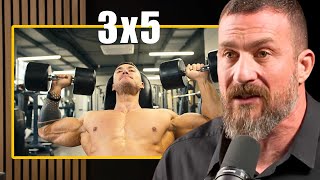
If you look at bodybuilding historically, guys were strong. They were absolutely extremely strong. So I think something happened in the culture where bodybuilders stopped valuing strength. Some bodybuilders, but there's one type of training that delivers great benefits to your cardiorespiratory system and even builds muscle in the same time. This is where you get both hypertrophy and strength. That's that beautiful combination. It works very, very well. One of the great things that's happened in the last 5 to 10 years is that adult men and women are thinking about muscle, the importance of having muscle and being strong in particular. Very different than when I was growing up where the only people at least in American gyms that lifted were preseason football players, bodybuilders, and maybe a few other niche groups. Now things have really changed. And I'll just go out on a limb and say what I believe and have thought for a long time, which is that what screwed up everything in terms of people's conceptualization about how to use resistance is bodybuilding. Somehow it it's so unathletic. >> Sure. >> In its approach. And I have friends who've done competitive bodybuilding and that sort of thing. Not too many, but but I feel like the way it's spilled over into quoteunquote gym culture has done equal harm and good. And and what I like so much about your work is that it's really about strength as a skill, strength as a an asset, for longevity. >> Yeah. >> And when I think about somebody who wants to be strong, somebody who wants to be healthy, I also have to ask, should people be training for strength and endurance? Like the two opposite ends of the spectrum, as opposed to what most people do, which is, hey, I'm going to go to the gym, maybe I'll push a sled, and then I'll, I'll know, I'll do some kettle bell swings, and then I'll also do some pull-ups, and then I'm going, you know, I'm going like take a picture of my tricep in the mirror. I mean, it just while it's better than doing nothing, >> yeah, >> it's clearly not making America that much healthier. So, maybe we could just kind of throw up on the on the whiteboard here this notion of training to get strong. Strength is a skill. Strength is something that's valuable for longevity. And then endurance, the ability to carry two suitcases to the airplane without coughing up along at the end. Also, the ability to take a hike with your partner or your kids, maybe actually have a backpack on your back and not have to stop every 50 paces. You see people who are strong and they have endurance. You go to Denmark or or Sweden or Norway and you just look at these people are so healthy. Their posture is great. They're strong and they're not spending a lot of time in gyms. Sometimes they are. So what's going on in terms of strength and endurance and maybe how bodybuilding and this notion of building muscle has perhaps caused some issues that we need to help people reconceptualize. >> Several great questions. Let's talk about bodybuilding and then before getting to endurance what you said it's absolutely true but I'd say that's there are different types of bodybuilding. If you look at bodybuilding historically guys were strong. I've had the honor of knowing some uh golden age era bodybuilders like Franco Columba and Dave Draper and Clarence Bass and these guys were formidable. They were not just pretty boys. They were absolutely extremely strong. So I think something happened in the culture where bodybuilders stopped valuing strength. Some bodybuilders, there's still a number of guys out there who are following traditional methods and they're strong. Also, interestingly enough, the bro split, you know, hit once a muscle once a week. It's not necessarily bad if you again follow more of a into this classic American powerlifting model. So instead of training three times a week, you train five. you know, in addition to your squat day, deadlift day, bench day, you can have shoulders day and arms day and whatever, but you go heavy. You know, look at Reg Park, his uh sets of five. For strength, you should stick in the one to six repetition range. You shouldn't do a lot of singles and doubles. Threes and fours should predominate, but fours and especially fives and sixes, this is where you get both hypertrophy and strength. That's that beautiful combination. And fives have a great tradition, American powerlifting as well. If you train with fives, you're going to get muscle and you're going to get strength and you're not going to complicate things. There are some bodybuilders out there who train in this particular manner and they're fantastically strong. Just not many of them, unfortunately. But I also would like to add that there's another influence that messed things up. I would take the bros of the '9s with a big bench press and the chicken legs to these guys who stand on balls and juggle oranges and whatever the hell they're doing. The idea is so there's the concept of neuroplasticity which obviously you know so much more than I about that's always throwing her out. Oh, you need variety. So they throw every circus trick at these poor clients. And by the way, I use the word clients purposefully. Like at Stone First at our school of strength, we have students because Harris lots of clients. But in that world, they're definitely clients. Well, today you're going to stand on one foot and then you're going to pull on this cable and then tomorrow you're going to kneel and you're going to do this kind of thing. There are way too many choices. And when there are no constraints, when everything's available, you go to a store, everything's available, you don't know what to pick and you can stick with that. So that's that's a very big problem. Endurance is a very broad term. And let's talk a little bit about training for athletes, for endurance, and let's talk maybe a little bit for the general population. We're trying to do for health and again for just going for a hike. The endurance of being able to do triathlon or swim a very long distance, the adaptations are primarily taking place in the slow fibers. and you have some very specific adaptations to the capillaries and the mitochondria, so many things, but in a very specific way. And that's not going to help you. Let's say if you're a fighter, it's happened over and over where a guy who's been marathoner, he takes up MMA and he starts getting gassed really rapidly. He's slow fibers can keep going forever, but not at the intensity that's required for this particular sport. So pretty much steady state, steady state exercise like riding a cycle or jogging or hiking when you're still able to talk. It's the best most efficient and healthiest way to to promote that quality when you're increasing your heart stroke volume. If you decide to get a little more intense at some point interval training is appropriate. There's one type of training that delivers great benefits to your cardiorespiratory system and even builds muscle in the same time. In track it is called glycolytic power repeats but pretty much like a 30 seconds of heart exercise followed by approximately 5 minutes of rest and you repeat it several times. Here's what's unique about this this type of method. It gets your heart rate up to about that 85 85 90% or something. Then you're going to walk it off after that. So you are going to get adaptations for your heart. For healthy people it's a healthy way and it's a very efficient way. Also what's interesting you're also likely to get build some muscle as well. Typically there is the conflict which we're getting to this point about like strength versus endurance. Things seem to be like okay this is pulling one way this is pulling the other way but somehow this particular load while promoting peripheral and central endurance also does promote muscle growth. >> Interesting. And what sort of exercise? This is not sprints. This would be kettle bell swings for instance. >> In in the studies that were done they use wing gates they use cycle. They they cycled sprinting. If you are going uphill, you can certainly do that. 30 seconds is hard. You're you're pushing. >> You're pushing. >> Yeah. >> Uh going in a track, it's too easy to get something messed up. So going uphill, you can do that. We do it with kettle bells. We did this work in my first kettle bell school over 20 years ago where we would do a set of you take a heavy kettle bell, moderately heavy kettle bell, like you know for you know for you or me to be like a 70 pounder and we would snatch it really hard for a set of 20 25 reps and then we just jog till the heart rate comes down and then we take this leisurely powerlifting rest and we're going to do it again. And it's a fantastic way to promote various aspects of fitness. So you're going to get cardiovascular endurance, you're going to have get peripheral adaptations, endurance in the muscle, and you're also building muscle at the same time. But the fact is doing a hard 30, 40 second set followed by a very generous rest, we're talking about 5, 10 minutes, and repeating it five times, possibly more, it it works very, very well.
Video description
Golden Era bodybuilders were built different — not just big, but brutally strong and capable. Here’s the training philosophy they used that built muscle with real power behind it — and how you can apply it today. Subscribe to RESPIRE for more science-based health tips: https://www.youtube.com/channel/UCyNaCRf6Aaljcm9ZWARawXw re·spire (verb) – (1) to breathe (2) to recover hope, courage, or strength 🌟🌟🌟 NEW VIDEOS EVERY WEEK 🌟🌟🌟 This video is a condensed and highly edited version of the full 255 minute podcast from @HubermanLab. For more information, watch the full episode (link below) and follow the podcast. Pavel Tsatsouline is a Belarusian-born fitness expert known for introducing Russian kettlebell training to the West. A former Soviet Special Forces physical training instructor with a sports science degree, he founded StrongFirst, Inc., focusing on "low tech/high concept" strength and resilience training for the general public, emphasizing practical strength over sheer size. Andrew Huberman is an American neuroscientist and tenured associate professor in the department of neurobiology and psychiatry and behavioral sciences at Stanford University School of Medicine. Podcast Host: Andrew Huberman Podcast Guest: Pavel Tsatsouline YouTube: @HubermanLab Source: https://www.youtube.com/watch?v=Z3OpxT65fKw&t=3s Fair Use Disclaimer 1. Under section 107 of the Copyright Act 1976, allowance is made for "fair use" for purposes such as criticism, commenting, news reporting, teaching, scholarship and research. Fair use is a use permitted by copyright statute that might otherwise be infringing. Non-profit, educational or personal use tips the balance in favor of fair use. 2. We do not own the rights to all content. They have, in accordance with fair use, been repurposed with the intent of educating and inspiring others. We must state that in no way, shape or form are we intending to infringe rights of the copyright holder. 3. Content used is strictly for research and education, all under the Fair Use law. #bodybuilding #buildmuscle #strength #endurance #functionaltraining #strengthtraining #kettlebell #fitness #healthtips