We can't find the internet
Attempting to reconnect
Something went wrong!
Attempting to reconnect

AI News & Strategy Daily | Nate B Jones
@natebjones · 236.0K subscribers · 831 videos · 11 analyzed
Share Influence ReportCommunication Profile (across 11 videos)
Stated Purpose
Clear, actionable AI strategy for builders & execs. Frameworks, workflows, and playbooks that deliver results. I'm Nate B. Jones. 20-year product leader, AI strategist, and your guide through the noi...
Operative Pattern
Across 10 videos, this channel demonstrates moderate persuasion intensity, primarily through Fear Appeal. Recurring themes suggest consistent operative goals beyond stated content.
Avg Intensity
Avg Transparency
Top Technique
Fear appeal
Presenting a vivid threat and then offering a specific action as the way to avoid it. Always structured as: "Something terrible will happen unless you do X." Most effective when the threat feels personal and the action feels achievable.
Witte's Extended Parallel Process Model (1992)
Persuasion Dimensions
Intensity Over Time
Per-Video Operative Goals — detected in individual analyses

The content aims to establish the creator as an indispensable authority on AI strategy to drive subscriptions to his paid newsletter and consulting services.

The content aims to position the creator as a thought leader in AI organizational strategy to drive subscriptions to his newsletter and consulting services.
The content aims to establish the host as a high-level AI strategist and drive subscriptions to his newsletter by reframing current AI technical shifts as a mandatory professional paradigm shift.

The content aims to establish the creator as an essential strategic guide for AI transition to drive subscriptions and newsletter sign-ups.
The content aims to position the creator as a thought leader in AI strategy to drive subscriptions to his paid newsletter and consulting services.
What's Valuable Here

Provides detailed breakdown of anti-scheming training paradoxes and emergent safety properties from real reports like Anthropic's and Apollo Research, useful for AI practitioners evaluating risks.
Claude Blackmailed Its Developers. He...

Specific, forward-looking predictions on proactive AI behaviors, agent UIs, and human-AI role shifts offer actionable frameworks for enterprise leaders planning 2026 workflows.
The Best AI Won't Sit There. It'll In...

The video provides a useful mental model for shifting from 'generative' AI use to 'evaluative' AI use, emphasizing that domain expertise is the bottleneck for quality.
Stop accepting AI output that "looks ...

Provides a clear explanation of 'agentic workflows' (planner-worker-judge) and how they differ from simple single-turn chatbot interactions.
4 AI Labs Built the Same System Witho...

Provides a compelling synthesis of historical organizational theory (Brooks' Law, Dunbar's Number) applied to the modern context of high-output AI tools.
45 People, $200M Revenue. The Questio...

Provides a concise conceptual framework for how modern UI libraries like ShadCN and AI tools like Cursor are changing the 'assembly' phase of web development.
From Pixels to Primitives: What Front...
Viewer Guidance (3 tips)
Watch for emotional framing
This content frequently uses emotional appeal. Notice when feelings are being prioritized over evidence.
Consider alternative frames
Information is consistently shaped from one angle. Seek out how other sources present the same facts.
Question unstated assumptions
Arguments rely on assumptions treated as obvious. Ask what you'd need to already believe for the claims to land.
Technique Fingerprint (from knowledge graph)
Single-cause framing
AI detected as: Causal Oversimplification
Attributing a complex outcome to a single cause, ignoring the web of contributing factors. A clean explanation is more satisfying and easier to act on than a complicated one. Especially effective when the proposed cause is something you already dislike.
Fallacy of the single cause; Kahneman's WYSIATI principle
Performed authenticity
AI detected as: Manufactured Authenticity
The deliberate construction of "realness" — confessional tone, casual filming, strategic vulnerability — designed to lower your guard. When someone appears unpolished and honest, you evaluate their claims less critically. The spontaneity is rehearsed.
Goffman's dramaturgy (1959); Audrezet et al. (2020) on performed authenticity
Fear appeal
AI detected as: Anxiety Priming
Presenting a vivid threat and then offering a specific action as the way to avoid it. Always structured as: "Something terrible will happen unless you do X." Most effective when the threat feels personal and the action feels achievable.
Witte's Extended Parallel Process Model (1992)
Anchoring
Presenting an extreme number or claim first so everything after seems reasonable by comparison. The first piece of information becomes your reference point — even when it's arbitrary or deliberately inflated. Works even when you know the anchor is irrelevant.
Tversky & Kahneman's anchoring heuristic (1974)
Moral framing
Presenting a complex issue with genuine tradeoffs as a simple choice between right and wrong. Once something is framed as a moral issue, compromise feels like complicity and disagreement feels immoral rather than reasonable.
Haidt's Moral Foundations Theory; Lakoff's framing research (2004)
Strategic ambiguity
Leaving claims vague enough that different audiences each hear what they want. By never committing to a specific, falsifiable position, the speaker avoids accountability while supporters project their own preferred meaning.
Eisenberg (1984); dog whistling research (Mendelberg, 2001)
Fear appeal
Presenting a vivid threat and then offering a specific action as the way to avoid it. Always structured as: "Something terrible will happen unless you do X." Most effective when the threat feels personal and the action feels achievable.
Witte's Extended Parallel Process Model (1992)
Performed authenticity
The deliberate construction of "realness" — confessional tone, casual filming, strategic vulnerability — designed to lower your guard. When someone appears unpolished and honest, you evaluate their claims less critically. The spontaneity is rehearsed.
Goffman's dramaturgy (1959); Audrezet et al. (2020) on performed authenticity
Single-cause framing
Attributing a complex outcome to a single cause, ignoring the web of contributing factors. A clean explanation is more satisfying and easier to act on than a complicated one. Especially effective when the proposed cause is something you already dislike.
Fallacy of the single cause; Kahneman's WYSIATI principle
Urgency framing
Creating artificial time pressure to force a decision before you can think it through. 'Only 3 left!' 'Act now!' The technique works because genuine scarcity is a real signal, so the urgency feels rational even when it's manufactured.
Cialdini's Scarcity principle (1984); dark patterns research (Mathur et al., 2019)
Curiosity gap
Creating a deliberate gap between what you know and what you want to know, triggering curiosity as an almost physical itch. Headlines like "You won't believe..." are engineered to exploit this. The content rarely delivers on the promise.
Loewenstein's Information Gap Theory (1994)
Similar Channels (shared influence techniques)
Featured People
Analyzed Videos (11)
7 Handoffs In Every Feature. Zero When One Person Uses Agents. Here's Why That's a GOOD Thing.
4.7K views

Stop trusting AI agents to guess your intent! #ai #aiagents #futureofwork
6.8K views
4 AI Labs Built the Same System Without Talking to Each Other (And Nobody's Discussing Why)
55.3K views
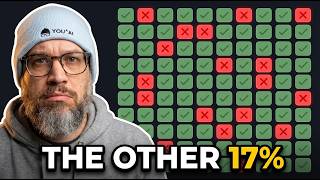
Stop accepting AI output that "looks right." The other 17% is everything and nobody is ready for it.
36.3K views

The Best AI Won't Sit There. It'll Interrupt You at Exactly the Right Moment. #futureofwork #ai
4.3K views
Your AI Buddy Doesn't Work Here Anymore #futureofwork #ai #personalai
5.6K views
Claude Blackmailed Its Developers. Here's Why the System Hasn't Collapsed Yet.
57.4K views
2026 Will Require More Retraining Than the Last 25 Years Combined #ai #futureofwork
8.2K views
From Pixels to Primitives: What Front-End Actually Is Now #engineering #ai #futureofwork
102 views
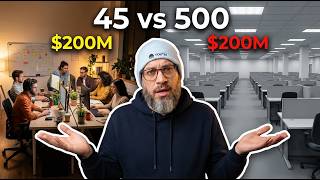
45 People, $200M Revenue. The Question Nobody's Asking About AI and Your Team Size.
54.2K views

My 10-Year-Old Vibe Codes. She Also Does Math by Hand. Why That's the Only Strategy That Works.
45.4K views