Prof Jiang Media
Executive Summary
Lectures featured on this channel are by Professor Jiang Xueqin. Prof Jiang Media curates, edits, and contextualizes his publicly available talks to make Professor Jiang's ideas presentable in a more accessible format. Join us as we dive into prima...
Across 10 videos, this channel demonstrates low persuasion intensity, primarily through Us vs. Them. Recurring themes suggest consistent operative goals beyond stated content.
Key Metrics
Us vs. Them
Dividing the world into two camps — people like us (good, trustworthy) and people not like us (dangerous, wrong). It exploits a deep human tendency to favor our own group. Once you accept the division, information from "them" gets automatically discounted.
Tajfel's Social Identity Theory (1979); Minimal Group Paradigm
Channel Rating
Moderate persuasion used transparently. The channel is upfront about its perspective — this is rhetoric, not manipulation.
What's Valuable Here

Application of game theory to model incentives of US, Iran, Israel, Saudi Arabia in potential conflict provides a structured framework for analyzing multipolar strategic traps.
Why America is Engineered to Destroy Itself in the Middle Ea...

Offers a provocative synthesis of historical events, psychological theories, and declassified programs like MKUltra with recommended readings for deeper exploration of power structures.
Why the State Manufactures Its Own Terrorists – Prof. Jiang ...

Offers a specific historical analogy framework contrasting virtue/reason (Robespierre) with charisma/myth (Napoleon/Trump) to predict political outcomes.
Why America Needs the Iranian Threat to Survive – Prof. Jian...
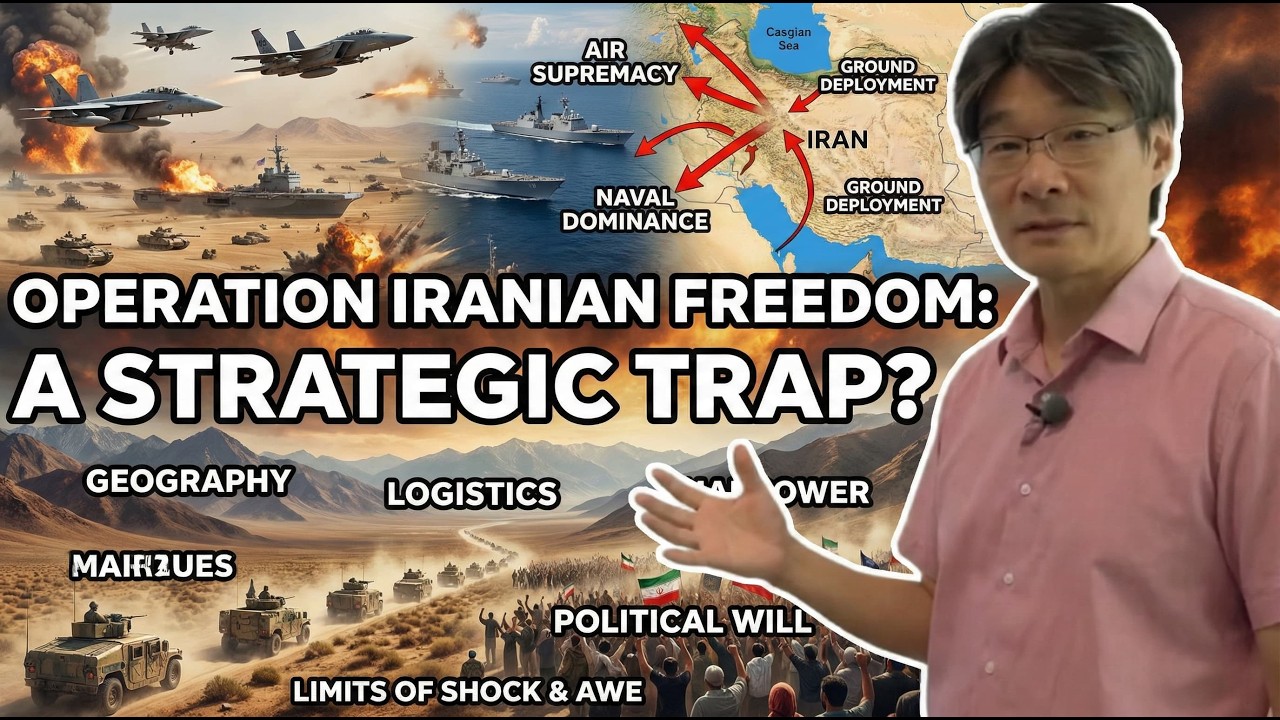
Provides a clear application of traditional military principles (mass forces, avoid encirclement, protect supply lines) to a modern hypothetical invasion scenario, offering structured strategic analysis.
Why America's War In Middle East for "Freedom" is an Illusio...

Provides detailed historical analogies (e.g., declining empires' counterproductive actions) applied to specific current events like Iran tensions and US domestic fractures, offering a structured framework for understanding geopolitical shifts.
Why America is Blindly Walking Into a Trap in Iran - Prof. J...

Provides granular breakdown of military doctrines like shock and awe vs. decentralized command, asymmetric costs of drones vs. THAAD missiles, and historical context of Gulf bases.
World War III and the Failure of American "Shock and Awe" – ...
Persuasion Dimensions
Most Used Techniques
Us vs. Them
Dividing the world into two camps — people like us (good, trustworthy) and people not like us (dangerous, wrong). It exploits a deep human tendency to favor our own group. Once you accept the division, information from "them" gets automatically discounted.
Tajfel's Social Identity Theory (1979); Minimal Group Paradigm
In-group/Out-group framing
Leveraging your tendency to automatically trust information from "our people" and distrust outsiders. Once groups are established, people apply different standards of evidence depending on who is speaking.
Social Identity Theory (Tajfel & Turner, 1979); Cialdini's Unity principle (2016)
Association
Pairing a new idea, product, or person with something you already feel positively or negatively about. The goal is to transfer your existing emotional response without any logical connection. It works below conscious awareness.
Evaluative conditioning (Pavlov); IPA 'Transfer' technique (1937)
Fear appeal
Presenting a vivid threat and then offering a specific action as the way to avoid it. Always structured as: "Something terrible will happen unless you do X." Most effective when the threat feels personal and the action feels achievable.
Witte's Extended Parallel Process Model (1992)
Moral framing
Presenting a complex issue with genuine tradeoffs as a simple choice between right and wrong. Once something is framed as a moral issue, compromise feels like complicity and disagreement feels immoral rather than reasonable.
Haidt's Moral Foundations Theory; Lakoff's framing research (2004)
Viewer Guidance
People or groups are reduced to types. Consider whether the characterization serves the argument more than the truth.
Information is consistently shaped from one angle. Seek out how other sources present the same facts.