We can't find the internet
Attempting to reconnect
Something went wrong!
Attempting to reconnect
Prof Jiang Media · 11.5K views · 3.9K likes
Analysis Summary
Ask yourself: “Whose perspective is missing here, and would the story change if they were included?”
Us vs. Them
Dividing the world into two camps — people like us (good, trustworthy) and people not like us (dangerous, wrong). It exploits a deep human tendency to favor our own group. Once you accept the division, information from "them" gets automatically discounted.
Tajfel's Social Identity Theory (1979); Minimal Group Paradigm
Worth Noting
Positive elements
- Provides granular breakdown of military doctrines like shock and awe vs. decentralized command, asymmetric costs of drones vs. THAAD missiles, and historical context of Gulf bases.
Influence Dimensions
How are these scored?About this analysis
Knowing about these techniques makes them visible, not powerless. The ones that work best on you are the ones that match beliefs you already hold.
This analysis is a tool for your own thinking — what you do with it is up to you.
Related content covering similar topics.
Why America is Engineered to Destroy Itself in the Middle East – Prof. Jiang Xueqin
Prof Jiang Media
LIVE: US-Israel war with Iran | BBC News
BBC News
Iran Claims USS Abraham Lincoln Hit by Missile — U.S. Navy Deploys E-6B Nuclear Command Aircraft
Fred in Focus
“21st Century Warfare” - U.S. BLASTS Iran Drones With LASER WEAPONS In Futuristic War
Valuetainment
How the War on Iran Will End the American Empire – Prof. Jiang Xueqin
Prof Jiang Media
Transcript
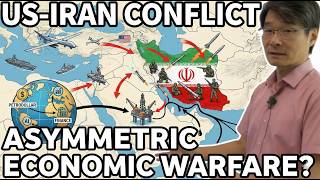
The big question that people have is first of all, are the Americans going to use ground troops? Because the only way that you can defeat Iran is by using ground troops. Okay, that's a big question we will look at in the next few weeks. Will will America send his army, half a million, 2 million soldiers to topple the government? Okay, that's question number one. Question number two, nuclear weapons. If you lose a war, would you choose to use nuclear weapons? Okay, that's another big question that we have. Okay. Now, another big question that we have is who gets involved? Because this situation is so dire that Europe, okay, specifically Germany, France and Britain are talking about entering this war. And guess what? If that happens, it is possible that Russia and China will also enter this war on the side of the Iranians. This is World War II. because of the importance of the political moves, because of the importance of the Middle East, everyone has to get involved at some point. And we're going to use game theory to really try to understand what what's happening on the ground and where this could lead us. There are American bases all over the Middle East. And originally, these bases were established to protect them from basically their own people. Okay, these are monarchies that were imposed on these nations by the Anglo-American Empire. The British first and then the Americans came to support these monarchies and so they provide defense. But then you're like, wait a minute here. I mean, didn't we just say that these American bases can actually defend these people that they're exposed? And the and the reason and the answer is yes, that's true. But remember that the American military was built during the Cold War. And the Cold War was a war between the Soviet Union and America. And so the Cold War was defined as something called MAD, mutually assured destruction, because both had nuclear weapons. Okay? So they didn't really go to war against each other. And so in other words, these bases aren't really meant to defend uh these nations from other enemies. They're really meant to impose American authority in the Middle East. Okay? And it's the idea of this. It's the idea that empire it is really a image. It is a hallucination. It's an idea. Empire is the it's an aura of invisibility and inability. Okay? If you fear it, then you obey it. But it's not really designed to fight a war. Okay? And and so that's why we have this absurd situation. And because there are so many bases in the GCC, that gives the Iranians the perfect pretext to attack them in order destroy the GC economy, which will destroy the American empire. So this is how the war shipping out. Okay. So, so the red is the Israelis and the Americans. The yellow are the Iranians. And as you can see, the Iranians are attacking everywhere, primarily Israel. Okay? But also, as you can see, a lot of focus on Bahrain and Qatar. And again, the intention is to destabilize the economy and the government. Okay? It's to try to get as much instability as possible. Okay? And as you can see, the Americans and the Israelis are focused on Tran. And so, the Americans and Israel use some something we call shock and all. And the very idea of shock and all is you decapitate the enemy. You cut off the head, the body will fall down. Okay. The problem though is again the Iranians see this as a religious war. And so the Iranians have of announced total war. Okay. And so what this means is that right now command and control in in Iran is decentralized. There's no one person telling everyone what to do. Every region has its own orders, has its own strategy. And so if you knock out terran, everyone else keeps on going. So you knock off the take off the head, it doesn't change anything. Okay? But unfortunately, the Israelis and Americans use this as a military doctrine. Military doctrine just means how to how you design your military for what purpose. And so the even though the Americans seem like an invincible army, they are not equipped to fight a 21st century war against drones, against dialization, against religious fanatics. Okay? They're just not right. But unfortunately, because of milit military doctrine, they're going to keep on attacking Tran. Now the great irony of all this is that the Iranians who will be most supportive of you of regime change are actually in the cities because they are educated. They're progressive. The people who are most fundamentally against you will fight you to the death are religious fanatics. The Shia militants living in the rural areas. Okay. So this is a really silly thing where you are actually destroying those who who will most likely support you and you're leaving alone those who are most likely to commit jihad against you. So another idea that I want you guys to understand is idea of asymmetry. Asymmetry. All right. So what is asymmetry? Asymmetry means that the two sides are choosing to fight different wars using different techniques because one is much stronger than the other. Okay. America is the great empire. It has unlimited resources. It has a USD. It has it controls the world, right? Iran uh is a country that has been under economic sanctions for the past 45 years. It's poor. It's technology is very limited. Okay. But as we learn in this class, actually those nations that are poor actually have more energy. They're more open and they're more cohesive. Right? So let me give an example. This is what we call the Shahad drones. Shahad drones. Each of these drones cost $50,000 at most. Okay, at most. It can go as cheap as $35,000. But one of them is one of them is $50,000. As you can see, you can fit a lot of these drones to a truck that can go anywhere in Iran and they can hide anywhere. All right. So, the thing to understand is first of all, these drones are cheap. They're easy and they're easy to make. They make about 500 a day. Okay. And estimates are about there's 80,000 um right now that the Iranians have. So they can go on for a long long time. Okay. And one of these drones again can knock out a dissalination plant. It can knock out a oil field. It can knock out a hotel. It can do a lot of damage and it's easily transportable. You can hide it anywhere. You can you can use it from anywhere. Okay. And that's what the Iranians are using as an offensive weapon. And how do the Americans defend against this? They use something called a THAD. Right. Right guys, this is what they use. THAAD. Thad stands for thermal high altitude air defense. And they also have like Patriot systems. There's a lot. Okay. The thing that you will that you need to know know about the system is it's really expensive. This missile guys cost $1 million. $1 million. So there's this $50,000 drone coming your way and you throw a million dollar missile at it. Okay? And often these missiles miss, so you have to throw two or three missiles at it. Okay? So you're you're spending two to $3 million on each $50,000 that the spend. That's kind of silly. Second thing you'll notice is that this thing is really big and really slow and therefore you can't really move it around. Therefore, it's pretty easy for the Iranians to spot where this is and attack it. And when these things blow up, that's a lot of money, guys. Then you're like, "What? But this makes no sense." You know, the Iranians have drones. They've had drones for like 10 years. You've also seen drones used in the Russia Ukraine war to devastating effect. Why don't the Americans know this? Why did they prepare? Okay. And again, it has to do with military military doctrine because military doctrine determines how you fight a war. It determines on your bureaucracy and it and it determines how you spend your resources. Okay? And unfortunately the Americans are used to fighting something called the cold war, right? And the cold war because you can't actually fight the war. You can actually use kill each other because then you people use nuclear weapons. The cold war was about flexing. Flexing. Okay. You see how big and powerful I am? Okay, that's all it was.
Video description
Check out Prof. Jiang Xueqin's recommended books to supplement his ideas: ► The Divine Comedy (The Inferno, The Purgatorio, and The Paradiso) by Dante Alighieri: https://amzn.to/3NZSkzt ► Anna Karenina by Leo Tolstoy: https://amzn.to/3ZQfsmy ► Confessions of an Economic Hit Man by John Perkins: https://amzn.to/4kskgs4 Check out the Prof. Jiang FULL curated reading list here: https://docs.google.com/spreadsheets/d/1yUE3DASNii2uPBuEcJKzF4iOjVPaU0nVThyaDUPPZWo/edit?usp=sharing The lectures featured on this channel are delivered by Prof. Jiang Xueqin. 🔗 Original lectures & channel: @PredictiveHistory A widening conflict in the Middle East raises a far more dangerous set of questions than the initial invasion itself. Would the United States ultimately commit massive ground forces—hundreds of thousands or even millions of soldiers—to topple the Iranian government? If a conventional campaign began to fail, would nuclear escalation become a real possibility? And perhaps most consequential of all, who else would enter the war? As tensions expand, European powers such as Germany, France, and Britain begin debating intervention, raising the possibility that rival powers like Russia and China could respond on Iran’s side. At that point, what begins as a regional conflict risks transforming into a global confrontation shaped by alliance systems, strategic deterrence, and the logic of great-power competition. Jiang Xueqin examines how the structure of modern military power complicates this scenario. Many American bases across the Gulf were originally constructed during the Cold War to project authority and maintain political stability among allied monarchies rather than to fight large-scale wars against regional powers. In a major conflict, these same bases could become vulnerable targets, offering Iran opportunities to destabilize the broader regional economy. The strategy of “shock and awe,” built around rapid decapitation strikes against central leadership, assumes that destroying command centers will collapse the opponent’s resistance. At the same time, the conflict illustrates the principle of asymmetry. A technologically advanced military may deploy highly sophisticated defense systems costing millions of dollars per missile, while its opponent relies on inexpensive, mass-produced drones capable of inflicting significant economic damage. When inexpensive systems can overwhelm costly defenses, the balance of warfare shifts away from spectacle and toward endurance. Turn on notifications to stay updated! 🔔🔔🔔 Here, we transform original content from interviews, lectures, podcasts, and keynotes featuring Jiang Xueqin to provide viewers with a more immersive and engaging experience. Our goal is to educate and inform as many people as possible about Jiang Xueqin’s unique economic insights and critiques of global capitalism. We also strive to make Jiang Xueqin’s ideas more accessible to individuals with hearing impairments by providing professional transcriptions for the majority of our videos. By enhancing the original content with cinematic editing, improved clarity, and added context, we aim to amplify Jiang Xueqin’s message and help more viewers understand the economic and social issues they address. Fair Use Disclaimer: 1. The videos have no negative impact on the original works. 2. The videos we create are for educational and commentary purposes. 3. The videos are transformative in nature. 4. We primarily use audio components and only minimal video footage when necessary. Copyright Disclaimer: Under Section 107 of the Copyright Act of 1976, allowance is made for “Fair Use” for purposes such as criticism, comment, news reporting, teaching, scholarship, education, and research. Fair use is permitted by copyright statutes that might otherwise be infringing. All rights remain with the original copyright holders. Disclaimer: • Content Context: This video contains discussions of theoretical perspectives and unverified information sourced from public discourse and various news outlets. It is presented solely for educational and informational purposes and should not be regarded as conclusive fact. • Intention of Content: We do not intend to defame, slander, or discredit any individuals or organizations mentioned. The content is designed to foster thoughtful discussion and critical thinking. • Non-Endorsement of Violence: We do not condone or encourage any form of violence described in the content. References to such actions are provided only for historical or analytical context. Our channel is not affiliated with Jiang Xueqin or any of their organizations and is purely made for entertainment and educational purposes. The content we share is based on facts, public commentary, and interpretations and should not be taken as financial or medical advice.