We can't find the internet
Attempting to reconnect
Something went wrong!
Attempting to reconnect
Analysis Summary
Worth Noting
Positive elements
- This video provides a high-level overview of the humanitarian 'secondary impacts' of regional conflict, specifically how violence in one area displaces resources from other crises like Sudan and Ukraine.
Be Aware
Cautionary elements
- The use of 'migration waves' as a rhetorical lever to convince a Western audience to care about a foreign conflict by framing it as a domestic security/demographic threat.
Influence Dimensions
How are these scored?About this analysis
Knowing about these techniques makes them visible, not powerless. The ones that work best on you are the ones that match beliefs you already hold.
This analysis is a tool for your own thinking — what you do with it is up to you.
Related content covering similar topics.

Ritter’s Rant 071: Give Peace a Chance?
Scott Ritter
China warns of spread of 'flames of war' from Iran
CNN
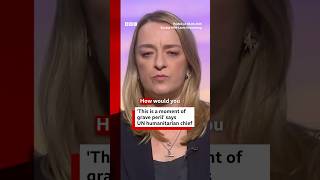
"This is a moment of grave peril" says UN humanitarian chief. #UN #Iran #BBCNews
BBC News
Iranian citizens ‘paying the price’ for the conflict
Sky News Australia
Humanitarian crisis looms in Lebanon as violence escalates in the Middle East
ABC News
Transcript
So this is a moment of grave grave peril right now. We're seeing a lot of unintended consequences to this military escalation and across the region we're seeing an impact on massive impact on civilians, hundreds of thousands displaced, needs rising very very fast. But we're also seeing secondary impacts on places like Afghanistan, Pakistan where needs were already great and where more people are being displaced. And then of course you know I have to worry about this as well. We're seeing all the other crises, South Sudan, Sudan, Ukraine, slipping even further down the list. So, I'm I'm really worried at the moment. >> Strikes have already hit, you know, homes, hotels, airports, all sorts of places that seem way beyond any kind of military targets. Do you fear that civilians actually are targets in this war? Well, it's not clear whether civilians are being targeted, but it's clear that civilians are paying the ultimate price here as always. And this is a time of brutality. It's a time of impunity. It's a time when I'm hearing that governments are spending a billion dollars a day on this conflict. And this is money that with which we could save millions of lives. >> How difficult is it for you already to get aid to where it's needed? I mean, not least in Iran itself where access is incredibly difficult. This is a real challenge. Of course, we have teams on the ground in many of the key countries, Lebanon, Syria, uh in Gaza and the West Bank and al Afghanistan, Pakistan, and elsewhere. We only have a very small team inside Iran, uh where of course a lot of the d the worst of the damage is taking place right now. I spoke yesterday to the Iranian ambassador in New York and offered again as I offer to all the governments of the region, humanitarian support if it's needed. At the moment, we're being told that they don't need that external support. We're scaling up what we're doing for refugees inside Iran, but at the moment there isn't that request for us to come in and do more, but obviously I'm monitoring that hourby hour. >> One of the things we've seen so far is an attack on a school. We don't know if it was deliberate or not, but what is the UN's view as we speak about who was responsible for that and whether it might be a war crime? >> So, the UN's view is protect civilians no matter what. Full stop. Unequivocal. It's there in the charter. All all countries have signed up to protect civilians. There must be a transparent full investigation and there must be accountability. >> The European Union's asylum agency has warned that there could be an almost unprecedented wave of refugees coming from Iran and the region and many people watching in the UK will therefore potentially have a concern about another wave of immigration. What do you think might happen and more and more people being on the move? So this is what I mean by the unintended consequences of this prolonged escalation, prolonged conflict. I think it's very easy to fire off huge amounts of expensive weapons. It's much harder to actually reflect on the long-term implications of that. And so you will see hundreds of thousands of people on the move. Understandably, wouldn't you move? Wouldn't I move if our homes and our schools and our hospitals were under attack in this way? And my concern is yes, that will create further tensions. uh across the region and beyond and will further fuel polarization and extremism and the sort of politics that actually leads to more conflict. We are seeing right now this sustained attritional attack on the rule of law on the institutions like the UN that are designed to prevent this kind of conflict. We've all got to take a deep breath. We need cool heads to prevail. We've got to step back from the brink right now. But is anybody going to listen to that call when you have an American president who said publicly, "I don't need international law, when you have Iran having ignored the pleas of the international community for years and years." Is anyone listening to the United Nations? >> I feel they're not listening as much as I wish they would. Uh we're in this sort of strong man moment right now. Muscular geopolitics. uh people resorting far too soon to uh weapons, guns, warfare rather than these institutions that we've built up at such with patience and at such cost because after the Second World War, we realized the danger to common humanity if we don't have these places where we can actually settle our differences peacefully. Right now, we're not being heard. We're not being listened to. Our job is to keep shouting loudly, to keep speaking truth to power, and keep demanding protection of civilians and accountability for those behind the violence. >> What would your message be to the UK foreign secretary this weekend? >> My message to the UK foreign secretary, as to all governments, is stand up for international law, back humanitarian action, back our efforts to reach the hundreds of thousands of people who need help right now. in addition to the millions globally who we're already trying to reach and try to bring people back to the table, try to bring people back to consensus uh and to the institutions that were built to prevent wars like this. >> Tom Fletcher, thanks so much for speaking to us. >> Thanks, Laura.
Video description
UN humanitarian chief Tom Fletcher has warned that the war in Iran and wider region is having a "massive impact" on civilians, describing it as "a moment of grave, grave peril". He also voiced concerns about "secondary impacts" of the violence, saying the conflict risked fuelling an increase in extremism and polarisation in the Middle East and beyond. "We've got to step back from the brink right now", he told the BBC's Laura Kuenssberg. Subscribe here: http://bit.ly/1rbfUog For more news, analysis and features visit: www.bbc.com/news #UN #BBCNews