We can't find the internet
Attempting to reconnect
Something went wrong!
Attempting to reconnect
Prof Jiang Media · 105.6K views · 3.8K likes
Analysis Summary
Ask yourself: “What would I have to already believe for this argument to make sense?”
Us vs. Them
Dividing the world into two camps — people like us (good, trustworthy) and people not like us (dangerous, wrong). It exploits a deep human tendency to favor our own group. Once you accept the division, information from "them" gets automatically discounted.
Tajfel's Social Identity Theory (1979); Minimal Group Paradigm
Worth Noting
Positive elements
- Provides specific linkages between Gulf petrodollar recycling, AI data center investments, and potential war disruptions, offering a focused economic-geopolitical lens on Middle East conflict.
Be Aware
Cautionary elements
- Us vs. Them framing that positions Iran as inevitably superior, potentially bypassing evaluation of balanced military economics.
Influence Dimensions
How are these scored?About this analysis
Knowing about these techniques makes them visible, not powerless. The ones that work best on you are the ones that match beliefs you already hold.
This analysis is a tool for your own thinking — what you do with it is up to you.
Related content covering similar topics.
Rubio Exposes Missile Gap Amid Iran War
Dr. SHIVA Ayyadurai, MIT PhD
This War Is The Political End Of Donald Trump – Dennis Kucinich
The Jimmy Dore Show
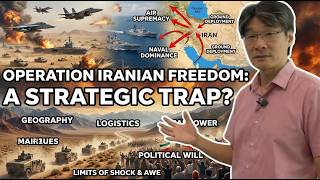
Why America's War In Middle East for "Freedom" is an Illusion I – Prof. Jiang Xueqin
Prof Jiang Media
World War III and the Failure of American "Shock and Awe" – Prof. Jiang Xueqin
Prof Jiang Media

📱WHO IS WINNING THE IRAN WAR? - w/ Stanislav Krapivnik
Mario Nawfal
Transcript
So given my analysis of how the war is progressing, I think that Iran has many more advantages over the United States. The reality is that right now it's a war of attrition between United States and Iran and Iranians have preparing 20 years for this conflict in their esquetology, in their religion. This is a war against the great Satan. They've had many practice runs. Last June was a 12-day war when the Iranians were able to examine analyze the strike capacities of both the Israelis and Americans and they've had a lot of time 8 months to prepare fully for this new attack. They through their proxies, the Houthi, Espalah, Hamas and the Shia mil militias have been able to really grasp the American mentality and now they have a pretty good strategy of how to weaken and ultimately destroy the American empire. So what the Iranians are doing is they're not they're waging war against the entire global economy. And so they are striking the GCC countries. And not only are they striking GC countries, American bases, they're going after the critical energy infrastructure of these bases. They bought up the tical moves and eventually they will go after the water dalidation plants which is a lifeblood of these nations because they don't have fresh water supply. In fact, the water desalination plant provides 60% of the GCG's water supply. So if a drone and you know these drones cost $50,000 if they wiped out a these plant in Riyad Saudi Arabia and it's a city of 10 million people right they'd be out of water in 2 weeks in 2 weeks and right now the Iranians have de facto closed off the shoo and the GC gets 90% of its food from the hummus. So I know a lot of people are talking about the disruptions to global economy but right now the Iranians are actually threatening the very existence of Saudi Arabia, UAE, Bahrain, Qatar. And why this is important is that the Gulf States are really the lynch pin of the American economy. So what they do is they sell petro dollars and then they recycle the petro dollars back into the American economy through the investments in the stock market. And right now we know that the entire glob the entire American economy is propped up by AI investments in data centers and a lot of that comes from the Gulf States. So if the Gulf states are no longer able to sell oil and they're no longer able to finance AI this AI bubble in the United States then this AI will burst and with it will will will burst as well as well the entire American economy which is really a financial Ponzi scheme. So that's that's a dire situation that the Americans are facing right now. You had in advance of this war on Iran, you had top military bras up to the chairman of the joint chiefs of staff saying this is a really bad idea. You know, we are not ready for this. You know, all the the math on the interceptors that's been talked about for for months at this point. And yet Trump still decided to go ahead. What is the calculus that he was making here that led him to take what you know already appears to be catastrophic actions? >> Right. Okay. So this is the key question. Why do they do this? I think there are three possibilities. Okay. And I think all three possibilities are valid. The first is the idea of hubris. If you look at history, this is how empires behave. So the Muro kidnapping was quick, successful and it was adrenaline rush for Trump and that made him overconfident in the capacity of the American military. Okay. So hubris is a factor and we see this throughout history. Why did Hitler invade Stalin? because he conquered Europe really easily and he thought it was invincible, right? And that led to the destruction of the German army in the Soviet Union. So hubris is a factor. Then you have to look at internal political calculus where even though America does not benefit from this war against Iran, Trump himself personally benefits. Why? Because the Saudis and Israelis are bribing him to attack Iran. Remember that the Saudis invested $2 billion in the private equity fund of Jared Kushner who is the son-in-law of Donald Trump and the Israelis through Miriam Aden have been financing Trump's vocal career. Right? So MD a few months back said that she will put up $250 million if Trump were to run a third term. So Trump is getting a lot of financial and political support from the Saudis and Israelis. Also remember that if this war if this war goes sideways and Trump is forced to use ground troops, he will probably get approval from Congress and this will give him emergency war powers which will allow him to influence the midterms. So Trump is thinking about a third term and I think at the botto elections and you have emergency war powers and people rally around the flag then you probably he probably will get a third term. And the last factor that is very important is the esqueological factor where if you look at the Epson files, it's clear that we are run by secret societies. It's clear that the world is run by these individuals who have a lot of power. We don't know who they are, but they control the military. They control the national security apparatus. And these people we we there are different names for these people. You can call them Illuminati. And the Illuminati are composed of three major groups. Okay? You have the Jesuits who control the Vatican. You have the 17 Frankus who which control the modern city of Israel today. You have the Freemasons which control the national security apparatus of the United States and they believe that Israel this war in the Middle East is key to the end times in creating heaven on earth. So it's almost like a script that they're following even though it's doesn't make any duplic uh sense. Okay. So I I would say that these three are the best reasons why this is happening. >> You about munitions. Uh we can put this next one up here on the screen. The United States is racing to accomplish Iran mission before munitions run out. This is specifically around interceptor math. There's a famous video just from yesterday in Israel which shows a single Iranian ballistic missile which is being targeted by some 11 different interceptors, all of which miss. Most of those come from the United States, not to mention all of the different bases, the GCC countries that you just talked about. And the as the asymmetry of the cost, it's a million dollar for a missile. tens of millions per interceptor in some of these cases with these munitions running out. How does that change the global picture? So you're in China obviously much of the stocks in Asia of the United States are likely to have to be cannibalized if this were to go on. How is that going to affect the global picture here? >> Right. So my first point is that United States military is not designed to fight a 21st century war. Remember the military industrial complex came to being after World War II and was designed to fight the Cold War. And the Cold War was really about muscle flexing about about who was able to send people up into space was able to who was the first get the person on the moon who had the more complex missile systems. And so the entire American military strategy revolves around very sophisticated sophisticated technology that cost a lot of money to build. And that's what the American air defense system is is basically. And that's why we're seeing this im asymmetry as you point out in in this war where you have these million-dollar missiles trying to take out these $50,000 drones and it's not sustainable in the long term. And so what we're seeing is really the puncturing of the aura of invisibility and inability that sustained American hegemony for the past 20 years u especially after the collapse of the Soviet Union. And this is really a reordering of not just the global economy because this signals the collapse of the petro dollar and with it the entire US dollarbased reserve currency system but also global the global hijgemony of the United States. We're moving towards a multipolar world. >> We were actually curious for your view on a disputed report here from the Washington Post. We can put it up here on the screen. Uh F3 a push from the Saudis. Israel helped move Trump to attack Iran. Now, this has been internally disputed by Saudi Arabia, saying that they did not push the Trump administration to attack Iran. However, this is clearly an authorized leak from our own government, trying to at least lay some of the blame on behalf of the GCC. What do you make of this analysis and of of this narrative that Saudi Arabia was also trying to be behind this push to bomb Iran? >> So, I've always argued that both Saudi Arabia and Israel are heavily invested in regime change in Iran. In fact, Saudi Arabia sees Iran as much more of an exceptional crisis than Israel because remember, Israel still has nuclear weapons and Israel is a very diverse, very sophisticated economy. Whereas Saudi Arabia is completely reliant on oil and it's always had problems with Iran because Iran is a theocracy opposed to the Saudi monarchy. Iran funds and equips the Houthies which have have been antagonistic towards Saudi Arabia for the longest time. And right now the Saudi economy is suffering. It is it's been trying to pivot towards more of a tourist economy. That's why they brought in Ronaldo. That's why they're switching to e- gaming. That's why they're being some building something called a line neon. And all these things are not working out. So they need to be able to control the oil resources of the entire Middle East if they are to survive and thrive as a nation. So I do believe that this uh reporting is credible even though it does make Saudi Arabia look bad. But remember, Saudi Arabia says that they wanted peace, but they are helping the Israelis and Americans attack Iran right now because they're allowing the Israelis and Americans to use Saudi airspace. >> This morning, Secretary of War Pete Hexath was asked a question about potential ground troops in Iran. He refused to rule out that possibility and he said, you know, oh well, we're not going to project to you what we will or will not do, but we don't want to, you know, rule anything out. we will do what it takes. Do you think that America will end up um invading Iran from the ground since it's already becoming relatively clear they won't be able to accomplish the goal of regime change or even regime collapse using just air power alone. >> Right? So everyone says that the worst calamity that could happen United States is if it were to send ground troops into Iran. The same time United States are committed to regime change in Iran. We've never had an president in history where you were able to regime change from the air alone. You need ground troops. And so unfortunately, what's going to happen over the next few months is that pressure will build on America to send ground troops, especially from the GCC countries and from Israel, which are being pounded right now by the Iranians. So remember that if the GCC countries, Saudi Arabia, Qatar, UAE, ban if they go, then the petro dollar goes goes with them. So, the Americans need to protect these countries, and these countries are going to demand that either the Americans bribe the Iranians to seize, and this this is like $5 trillion in indemnity, okay? Or send ground troops to wipe out the Iranian threat once and for all. And I know that there's no political will for ground troops to be used against Iran among the American people, but remember that 78% of American people was against initial strikes against Iran in the first face.
Video description
Check out Prof. Jiang Xueqin's recommended books to supplement his ideas: ► The Divine Comedy (The Inferno, The Purgatorio, and The Paradiso) by Dante Alighieri: https://amzn.to/3NZSkzt ► Anna Karenina by Leo Tolstoy: https://amzn.to/3ZQfsmy ► Confessions of an Economic Hit Man by John Perkins: https://amzn.to/4kskgs4 Check out the Prof. Jiang FULL curated reading list here: https://docs.google.com/spreadsheets/d/1yUE3DASNii2uPBuEcJKzF4iOjVPaU0nVThyaDUPPZWo/edit?usp=sharing The lectures featured on this channel are delivered by Prof. Jiang Xueqin. 🔗 Original lectures & channel: @PredictiveHistory This video examines the escalating confrontation between the United States and Iran through the lens of geopolitical strategy, military economics, and the fragile architecture of the global financial system. Professor Jiang Xueqin argues that what appears to be a conventional military conflict is in reality a broader war of attrition—one that targets the foundations of American power rather than its battlefield capabilities. According to this perspective, Iran has spent decades preparing for asymmetric confrontation, refining strategies through regional proxy conflicts while studying the technological and psychological assumptions underlying U.S. military doctrine. Jiang suggests that the real battlefield extends beyond missiles and drones into the infrastructure that sustains the global economy. Energy networks, Gulf state security, and the petrodollar system all become strategic pressure points in this framework. If instability in the Gulf disrupts oil flows and investment capital recycled into American markets, the consequences could ripple through sectors like artificial intelligence and finance that rely heavily on foreign capital. The analysis ultimately frames the conflict as part of a larger transition in global power—from a unipolar system dominated by the United States toward a more fragmented multipolar order where regional powers increasingly challenge American economic and military supremacy. Turn on notifications to stay updated! 🔔🔔🔔 Here, we transform original content from interviews, lectures, podcasts, and keynotes featuring Professor Jiang Xueqin to provide viewers with a more immersive and engaging experience. Our goal is to educate and inform as many people as possible about Professor Jiang Xueqin’s unique economic insights and critiques of global capitalism. We also strive to make Professor Jiang Xueqin’s ideas more accessible to individuals with hearing impairments by providing professional transcriptions for the majority of our videos. By enhancing the original content with cinematic editing, improved clarity, and added context, we aim to amplify Professor Jiang Xueqin’s message and help more viewers understand the economic and social issues they address. Fair Use Disclaimer: The videos have no negative impact on the original works. The videos we create are for educational and commentary purposes. The videos are transformative in nature. We primarily use audio components and only minimal video footage when necessary. Copyright Disclaimer: Under Section 107 of the Copyright Act of 1976, allowance is made for “Fair Use” for purposes such as criticism, comment, news reporting, teaching, scholarship, education, and research. Fair use is permitted by copyright statutes that might otherwise be infringing. All rights remain with the original copyright holders. Disclaimer: • Content Context: This video contains discussions of theoretical perspectives and unverified information sourced from public discourse and various news outlets. It is presented solely for educational and informational purposes and should not be regarded as conclusive fact. • Intention of Content: We do not intend to defame, slander, or discredit any individuals or organizations mentioned. The content is designed to foster thoughtful discussion and critical thinking. • Non-Endorsement of Violence: We do not condone or encourage any form of violence described in the content. References to such actions are provided only for historical or analytical context. Our channel is not affiliated with Professor Jiang Xueqin or any of their organizations and is purely made for entertainment and educational purposes. The content we share is based on facts, public commentary, and interpretations and should not be taken as financial or medical advice.