We can't find the internet
Attempting to reconnect
Something went wrong!
Attempting to reconnect
Analysis Summary
Ask yourself: “What would I have to already believe for this argument to make sense?”
Presupposition Of Interventionism
This technique was detected by AI but doesn't yet map to our curated glossary. We're tracking its usage patterns.
Worth Noting
Positive elements
- This video provides a rare look at how top-tier military planners view the limitations of their own power, specifically the admission that military force often fails to achieve political outcomes.
Be Aware
Cautionary elements
- The framing of the conflict as an inevitable 'regional war' may lead viewers to accept escalation as a fait accompli rather than a policy choice.
Influence Dimensions
How are these scored?About this analysis
Knowing about these techniques makes them visible, not powerless. The ones that work best on you are the ones that match beliefs you already hold.
This analysis is a tool for your own thinking — what you do with it is up to you.
Related content covering similar topics.
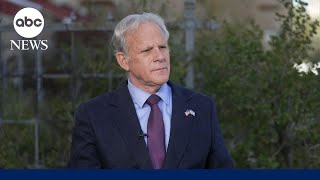
Former Israeli ambassador on the possibility of ground troops in Iran
ABC News
Glenn Diesen 3/2/2026
douglasmacgregorTV
Iran's Missiles DEVASTATE Haifa Port & Tel Aviv, Trump Eyes Ground War | Elijah Magnier
Danny Haiphong
The Great Lie of War | The Ezra Klein Show
The Ezra Klein Show
Iran's Missiles DECIMATE Israel & Gulf, Trump STUNNED as Russia Enters | Stanislav Krapivnik
Danny Haiphong
Transcript
And joining me now is former chairman of the Joint Chiefs of Staff, Admiral Mike Mullen, who served under presidents George W. Bush and Barack Obama. Good morning to you, Admiral. From what you have seen, do you believe this war is justified and the objectives clear? >> Well, Martha, I think the the uh debate about how we got in, when we got in, why we got in will continue. Um uh and I'm much more focused now on the fact that we're in and how can we make it come out well. I think the the objectives uh which have initially been somewhat all over the place uh have been reduced down to make sure they can never develop a nuclear weapon. Make sure we take out their entire missile capability in a way that it can't be rebuilt for a number of years. I thought the chairman Kaine said the other day uh made a good statement the other day about making sure they can't operate outside their their borders. Uh we've eliminated their navy. We've basically eliminated their air force. Um and uh and then is there a possible way now to limit further objectives to be able to end this thing on positive terms? And and I think that's the open question. Certainly the discussion of regime change is very much alive at this point in time. >> And and about regime change, one of the things the administration said, the president said is he said rise up and take over. This opposition isn't particularly organized, what do they do? And do you see the IRGC laying down their arms? Uh one of the one of the data points for me is uh that often gets overlooked is the the basically the military IRGC besiege run about 40% of the GDP of that country and and so displacing them from that I think is an extraordinarily difficult and challenging and timeconsuming uh uh objective specifically. Um and yes, uh the supreme leader is dead, but I don't think the regime change that we're talking about is represented just by that because I think the regime is embedded deep uh dedicated uh and sees this war as a war of survival for Iran. Uh and uh survival itself is something that sometimes we don't quite get right. uh they're going to sacrifice everything they've got in order to make sure that they can survive and I think they'll draw the war out very specifically. So the regime change that needs to happen is deep uh and and it's also uh you know at at a time in the country that's it's very vulnerable but there's a real question as to whether we can generate that and our track record in Iraq where we actually chose the leader in Afghanistan where we chose the leader uh was uh was pretty bad. Uh so it's a very very difficult undertaking and you know and I question whether we can really impact that >> and and you brought up Iraq and Afghanistan. What lessons did you take with you from those conflicts that apply today? >> Well, and I think it's typical almost in any war. Wars expand, objectives change, circumstances come up that you didn't expect. And I worry this has already become a wide regional war. Uh and I worry that without some kind of uh thoughtful limits on where we're going and how we're going to get there that it will continue to expand. I mean it's gone from very local to now involving discussions about Russia's involvement. Uh the president's got a visit with China at the end of this month which is a huge issue and China's watching this. So there's an awful lot at play in this war in addition to just the tragedy associated with those that are those that are dying. Believe me, this is a bad regime. Uh we all wish it had gone away a long time ago. Uh I think that's going to be a challenge in the future. H but we need to contain them. Uh we've got friends and allies out there. We've got the economy of the world in great part depending on uh on the open uh uh waters at the straits of Hormuz and how markets react to this. You've got a tourism uh economic uh livelihood in the region that's actually completely stopped right now. So there's an awful lot in play that we can't anticipate. And certainly that was the case in Iraq and Afghanistan. And I worry about this getting drawn out. These wars just don't end quickly. At least they certainly haven't in the last several decades. >> So your biggest concern at this point is not necessarily tactical, it's strategic. >> You know, I'm struck, Martha, with I look at that 12-day war and how much of their missile inventory was left. Uh, I look at the number of targets that I hear publicly, which is over 4,000 targets hit so far, which is an extraordinary number of targets, and yet Iran is still responding. So, I don't know how deep their inventory is. Uh, I think they want to look as strong as they can. They want to destabilize the region as much as possible. Um, and and uh, and we will continue, I'm sure, from a military standpoint, to be able to to take them out. uh the objective of keeping them operative only inside their borders is a huge objective, but we're a long way down the line of being able to make that happen. It's not the military aspect of this that I'm concerned about. It's the military objectives in support of a acceptable political outcome uh that is obvious very much in play and and somewhat uncertain right now. >> It seems uncertain indeed. Thanks very much for joining us this morning, Admiral.
Video description
ABC News’ Martha Raddatz interviews retired Adm. Mike Mullen on “This Week.” ––– Subscribe to ABC News on YouTube: https://abcnews.visitlink.me/59aJ1G ABC News is your daily source of breaking national and world news, exclusive interviews and 24/7 live streaming coverage. https://abcnews.com Download the ABC News app for the latest headlines and alerts: https://abcnews.com/devices Connect with ABC News on social media: Facebook: https://www.facebook.com/ABCNews Instagram: https://www.instagram.com/abcnews TikTok: https://www.tiktok.com/@abcnews X: https://twitter.com/ABC Threads: https://www.threads.net/@abcnews WhatsApp: https://whatsapp.com/channel/0029VajTNakKWEKkXoAPIR11 LinkedIn: https://www.linkedin.com/company/abcnews