We can't find the internet
Attempting to reconnect
Something went wrong!
Attempting to reconnect
Analysis Summary
Moral framing
Presenting a complex issue with genuine tradeoffs as a simple choice between right and wrong. Once something is framed as a moral issue, compromise feels like complicity and disagreement feels immoral rather than reasonable.
Haidt's Moral Foundations Theory; Lakoff's framing research (2004)
Worth Noting
Positive elements
- This video provides a detailed look at how the UK government attempts to balance its alliance with the US against domestic legal constraints and national interest during wartime.
Be Aware
Cautionary elements
- The use of 'institutional neutrality' to present the UK's specific foreign policy choices as the only 'lawful' or 'thought through' option.
Influence Dimensions
How are these scored?About this analysis
Knowing about these techniques makes them visible, not powerless. The ones that work best on you are the ones that match beliefs you already hold.
This analysis is a tool for your own thinking — what you do with it is up to you.
Related content covering similar topics.
China Just SHOCKED The World and Iran Is Now FINISHED!!!
Dr. Steve Turley
Why America is Engineered to Destroy Itself in the Middle East – Prof. Jiang Xueqin
Prof Jiang Media
LIVE: US-Israel war with Iran | BBC News
BBC News
How the War on Iran Will End the American Empire – Prof. Jiang Xueqin
Prof Jiang Media

World War III and the Failure of American "Shock and Awe" – Prof. Jiang Xueqin
Prof Jiang Media
Transcript
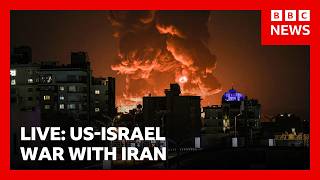
Hello, I'm Karen Jinoni. It's day nine of the US Israel war with Iran and over the next 10 minutes or so, we'll bring you our daily briefing with all you need to know and the key updates on the conflict. Iran appears to be getting closer to agreeing as new supreme leader to replace Ayatollah Ali Ham. State media says the assembly of experts has reached a consensus on a successor, but there hasn't been an official announcement. It comes as the US and Israel hit oil facilities in Tehran with intense aerial bombardment. Israel's president says bombing Iran is being done on behalf of the entire free world. Iran has fired another missile barrage towards central Israel. First responders say six people were wounded and pictures show a blast hole in a street in Tel Aviv. We begin though with the state of the UK US special relationship which has taken a turn since the start of this conflict. In its latest development, Downing Street says Sakir Stalmer has spoken to President Trump about the situation in Iran. Well, last night the US president accused the UK of trying to join a war that he said had already been won. In a post on Truth Social, Donald Trump said, "The United Kingdom, our once great ally, may be the greatest of them all, is finally giving serious thought to sending two aircraft carriers to the Middle East. That's okay, Prime Minister Starmer. We don't need them any longer, but we will remember. We don't need people that join wars after we've already won." It came after one of the UK's two aircraft carriers was placed on advanced readiness and US bomber jets were seen landing at RAF Fairford. My colleague Nick Johnson is there. These are B1 bombers. They're some of the largest, heaviest, fastest bombers in the world. They arrived here yesterday as part of that agreement from the Prime Minister Sakir Star. He said that US forces can use this base as part of the Iran conflict, but for defensive measures only. We've seen other aircraft arrive here today as well. US military transport planes. They carry parts and munitions for the bombers. Two of those planes arrived from an Air Force base in North Dakota, the same Air Force base where large B-52 Stratofortress bombers are based, suggesting that they might arrive at RAF Fairford in the coming days as well. RAF Fairford has a long history of partnership with the US Air Force. It's been used by the United States since the 1950s. It's also got one of the longest runways in the UK, coming in at just under 2 mi long, and it sits halfway roughly between the eastern seabboard of the US and the Persian Gulf, making it a strategic location for refueling and rearming. >> Nick Johnson. Well, let's cross live to our political correspondent Damian Grammaticus. And Damian, how is the special relationship looking today? Well, Karen, it's a little bit rocky is how things look. I mean, I think you have to think there are two different levels of this. There is the level of the sort of military cooperation, the intelligence corporation, the partnerships that operate on a day-to-day level and the indications all are that those continue uh and what you saw at that air base in Glosseser is exactly that. The government's made that point that's this happening in action. But at the level of leaders, well then it's not great at the minute. You have to say those pretty tety pointed dismissive remarks from President Trump when the UK is looking at the possibility of sending an aircraft carrier just I think illustrative of that. Now Karma spoke has spoken to President Trump today. their first call, interestingly since the very start of the war, so in a week. And in a very kind of brief tur statement from Downing Street, they said that the the leaders discussed the military cooperation between the countries and the use of RF bases in support of collective self-defense of countries in the Middle East. That's the key point. Collective sense self-defense. That's what the UK is limiting cooperation to. That's why President Trump uh has been irritated. But what we've heard today from UK ministers, they are determined they say to take decisions in the UK national interest not to outsource foreign policy and that is they say all then the decisions are dependent on is any action going to be lawful and is it part of a thought through plan and and the UK so far has not been convinced of that. >> Damian, thank you. Iranians are waiting to learn the name of their new supreme leader after clerics from the assembly responsible for finding a successor announced they had made a choice. There is mounting speculation it'll be the son of the late Ali Ham Mushtabar. Bang Tajin from BBC Persian has more. >> It's the 88 clerics of the assembly of leadership expert who will choose the next supreme leader of Iran. But with the war raging and Israel threatening to target them, the members of the assembly have yet to formally meet in person. However, a couple of them have said that actually they have made a decision and one has said that it is the same person that the great Satan by which they mean the United States has mentioned that indicates that it could be Muchab the 56 year old son of the late Supreme Leader Ayatah Ali however much has never stood for elections held any public office or even given a public speech. But if he is chosen, and that is a big if, right now, many expect him to pursue the same hardline policies and take the same positions as his predecessor and father, Ali K. >> Oil depots in Iran were hit overnight by intense USIsraeli aerial bombardment, with locals reporting multiple explosions and a sky thi blackened with thick smoke. My colleagues at BBC Persian have received some messages from people inside Iran. We've voiced up their words. >> Car was calm for a day, but now it has turned wild again. They have blown it up. Oil deputistan areas. It was as if the night has suddenly turned into day. >> The city is really covered in smoke. You can smell the burning. I can't see the sun. There is a horrible smoke. It's still there. I'm very tired. I've been indoors the whole time. >> Well, for more on the impact the war is having on people living in the Middle East, the BBC's been speaking to the UN's humanitarian chief Tom Fletcher. He's described this as a moment of grave, grave peril >> across the region. We're seeing an impact on massive impact on civilians. Hundreds of thousands displaced, needs rising very, very fast. But we're also seeing secondary impacts on places like Afghanistan, Pakistan where needs were already great and where more people are being displaced. And then of course, you know, I have to worry about this as well. We're seeing all the other crises, South Sudan, Sudan, Ukraine slipping even further down the list. So I'm I'm really worried at the moment. >> A couple of other developments to bring you today. Lebanon's government says nearly 400 people have been killed in a week of Israeli strikes. Israel's massed forces along the border and repeatedly told people in southern Lebanon and the southern suburbs of Beirut to evacuate. The Lebanese government says almost half a million people have registered as displaced since fighting began. A drone strike on a government building in Kuwait sparked a huge fire overnight. Attacks have been reported across the Gulf with explosions heard in Abu Dhabi. The United Arab Emirates says it detected 238 ballistic missiles from Iran in the past week. Well, as we enter the second week of the USIsraeli war with Iran, where do things stand for the region and for the wider world and where could this conflict be heading? Those are some of the questions people are searching most. And here with me to try to give us some answers, our chief international correspondent, Lee Ducet. Hello to you, Le. First of all, has this gone the way the US expected? >> Well, we don't really know how what the US expected, what Israel expected in the first week because there were some reports that they believe that once they had assassinated the top cleric Ayatollah in the very first salvos on that Saturday, February 28th, that the regime would would would collapse, which of course hasn't been the case. But what the Pentagon has been saying and President Trump and his secretary of defense or secretary of war as he calls himself, what they've been saying is that they're ahead of schedule, that they have made an extreme faster progress than they expected. They give the figures that more than 60% of Iran's ballistic missiles um have been destroyed, that they have near control, near complete control of the skies, and of course they have killed dozens of top clerical and security officials. President Trump even admitted that some of the people they had in mind to replace Ayatollah Hame had actually been killed. But the regime is still standing. There's been no defections and there's been no cracks. >> Lots of people on on Tik Tok asking what is the plan heading into week two? Do we know where this goes next? Well, since President Trump really likes Tik Tok, maybe the Tik Tockers should ask President Trump, "What do you really want, President Trump, when you have sent your country into war?" He says different things, different days. Uh, first we thought with his first statement on um the early hours of February the 28th that he he was calling on Iranians to rise up after the bombing was over. So, people thought this is about regime change, bringing down the regime. Then he made it clear he wanted something like Venezuela. And I'm sure Tik Tockers and our viewers in general know what happened in Venezuela. They extracted the president Nicholas Maduro. No American casualties, no chaos. President Trump had a say in who or at least there's Deli Rodriguez. He's working with her and he in effect wants a Deli Rodriguez type person that he can work with in Iran. He has said he wants to be involved in choosing the new leader to which Iran said there is no possibility of that and in fact the system in Iran layers and layers of security ideological political uh institutions there's no way there will be a Venezuela situation in Iran. Le thank you very much Lee Ducet. Well whether you're joining us on YouTube, Tik Tok, BBC Sounds radio or TV, thanks for being with us. We will be back at the same time tomorrow with the Iran war today. Goodbye.
Video description
Sir Keir Starmer and Donald Trump have spoken for the first time since the US president angrily criticised the UK's Iran response. On Saturday, the US president said the UK was considering sending aircraft carriers to the Middle East but dismissed the prospect, writing on social media "we don't need people that join Wars after we've already won!" - while labelling Britain "our once great ally". Sir Keir has previously said the UK would not join offensive actions, but agreed to let the US use British bases for defensive strikes on Iranian missile sites. Meanwhile, a member of Iran's Assembly of Experts says it has reached a consensus on who wil replace Supreme Leader Ayatollah Ali Khamenei, but some "obstacles" remain in the appointment. Subscribe here: http://bit.ly/1rbfUog For more news, analysis and features visit: www.bbc.com/news #BBCNews