We can't find the internet
Attempting to reconnect
Something went wrong!
Attempting to reconnect
Butcher Wizard · 53.6K views · 2.5K likes
Analysis Summary
Ask yourself: “Did I notice what this video wanted from me, and did I decide freely to say yes?”
Anchoring
Presenting an extreme number or claim first so everything after seems reasonable by comparison. The first piece of information becomes your reference point — even when it's arbitrary or deliberately inflated. Works even when you know the anchor is irrelevant.
Tversky & Kahneman's anchoring heuristic (1974)
Worth Noting
Positive elements
- The video offers high-quality, practical instruction on beef anatomy and specific knife techniques for breaking down subprimal cuts.
Be Aware
Cautionary elements
- The use of 'free' high-ticket physical goods to drive digital subscriptions can obscure the long-term cost of the membership.
Influence Dimensions
How are these scored?About this analysis
Knowing about these techniques makes them visible, not powerless. The ones that work best on you are the ones that match beliefs you already hold.
This analysis is a tool for your own thinking — what you do with it is up to you.
Related content covering similar topics.
I Took A Ribeye Steak And Made It Better
Butcher Wizard
Stop Overpaying For Prime Rib! Do This Instead!
Butcher Wizard
Stop Wasting Money On Pork Chops! Do this Instead
Butcher Wizard
Get More Ribeyes For LESS Money With This Method
Butcher Wizard
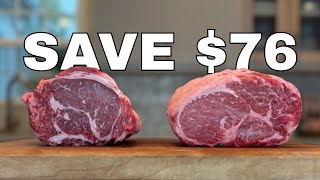
Does A Cheaper Prime Rib Alternative Exist? Let Me Show You!
Butcher Wizard
Transcript
This is a whole chuck roll. All 23 and a half pounds. That's a big cut of meat. Chuck roll is quietly one of the best buys in the meat game. It has steaks, you have roasts, you have ground beef. We got everything in this big subprimal cut. And here's the kicker. I paid $549 per pound for this whole big cut of meat. Today, I'm going to show you how to unlock all of the secret cuts in here. And it's going to be awesome. And I want to compare what we get out of this chuck roll and compare it to how much you would pay at the grocery store if we bought all these cuts individually. It's going to be fun. Come with me. Let's go do it. All right. So, the chuck roll is one of the two subprimal cuts that are in the chuck. And the chuck is that front shoulder of the cow. Now, there are two ends to the chuck roll. And this is the first challenge that we're going to have in orientation. So you have one side over here that looks like a little bit of a ribeye. And that is because on this side would be the rib section. So it would go into the rib section. On this side you have a thinner kind of piece that actually connects to the neck portion of the cow. So we have the rib on this side and the neck on this side. So it sits right in the middle. where we get a lot of our value is from this side where the chuck connects to the rib because we're gonna find a little secret cut. I'm going to show you that first. Let's do that. So, on this top side, there's a little bit of this kind of gnarly connective tissue that we're going to take off first. So, again, you take your knife, you can take your bow knife or a breaking knife, depending on how big this section is, and just go underneath and get all of this connective tissue here. This is not good to eat. It's going to be super tough and super chewy. So, we want to make sure we remove that first. Then kind of feel around if there's any bone fragments. Sometimes they're in the breaking down process. There might be something crazy in here. So, we're just going to kind of feel around. I think we're good. Um, we're going to take all this connective tissue off at a later time. So, right now, we're just going to flip this whole thing over to expose the chuck eye. So, that's our first golden cut here is the chuck eye. So, starting right here in this rib end, we are going to cut right between this fat layer right here, and we're going to release this chuck eye. Now, the chuck eye is interesting because it is actually the ribeye that has gone into the chuck. So, the rib is here and then the rib eye goes all the way down, but it gets smaller and smaller as we go down. So, there's a little tiny piece, there's a little like 6 in section that is the chuck eye. So we can get a chuck you can get get a ribeye for a chuck price which is kind of fun. So we're going to do is go right in between that fat layer and then pull it back. And as we pull back we go ahead and we make a little cut right here like like this. Okay. Once we get about four or five inches in that is where our premium chuck eye is. That's where we're going to get the most tender. It gets a little chewier as we get down closer to the neck. If you've seen this channel any any length of time, you know that we talk about tenderness and flavor, and it's going to get tougher and tougher the closer you get to the neck of the cow. The most tender cuts of the cow come from the parts that are furthest away from the hoof and the horn. So, the horn's about like here. So, it's going to get tougher and tougher as we go down. So, as we get down here, like I said, about four to five inches, we're then going to take our breaking knife, and just cut this chunk out, this steak out, or this roast out, I guess. And again, we've cut this way, and then we're going to cut this way so that we get our chuck eye roast right here. So, look at that. Doesn't that look like a ribeye? And on this side, it looks like a ribeye. It's just a little more. It's just smaller. So again, we're talking five bucks a pound here, people. Five, six bucks a pound. So you got a ribeye for the a really cheap price. Are you liking this video so far? If you are, then I have something for you. I made the Primal Cuts Club just for you. The Primal Cuts Club is my private membersonly community in which I will deep dive and teach you how to cut meat at home. This is only the tip of the iceberg really. We have so many other cuts that we can actually save money and cut at home. I teach you to do that by these online training videos that are available in the members area. It's different than my normal YouTube videos. You don't have to listen to ads first of all and foremost that and you also I just deep dive. So just the cameras right here focusing on the meat and nothing else. Twice a month if you have questions we have Q&A sessions live. Those give you the ability to ask me a question directly. We can have a conversation which we cannot have on YouTube. And if you're listening to this video as it releases in January/February, we are having our first contest. We're doing a cut test. So the cut test is basically way that butchers use to prove how much money they are saving um cutting these big cuts of meat. And I'm going to show you that process in depth. And if you go ahead and you buy a subprimal cut like a ribeye or something and you do the cut test, you're going to be entered into a drawing for lots of prizes. It's going to be fun. It's really going to be fun. I really would like to connect with you and offer a place for you to connect with other meat enthusiasts. Go ahead and check the link in the description and join the Primal Cuts Club now so you can be part of this contest that's coming up. That would be awesome. I can't wait to get to know you inside of the club. If you join the Primal Cuts Club right now, I have a special offer for you. I am going to give you two free gifts for joining the Primal Cuts Club. The first one is a 10-in breaking knife from the Butcher Wizard collection, and I'm going to give it to you for free. It's a $60 value if you go on Amazon, 60 bucks. But I'm going to give it to you for free if you sign up for the Primal Cuts Club. That's how much I want you in this club. We're going to I really want to meet you and see you in that club so you can learn how to save a ton of money. The second one is the 12in meat slicing knife from the Butcher Wizard collection. That's a $50 value. So again, all you have to do is go ahead and sign up through the QR code or the link in the description and I will send you those knives and then I cannot wait to connect with you in the club. We got so much cool stuff coming this year. I'm so excited about it, you know. Thank you so much for your consideration. And you know what? Let's get back to the chuck roll. We're going to come back to this and go ahead and portion it out later. All right, the next piece we're going to do is we're going to take the rest of this kind of chuck eye roll or this chuck eye roast. We're going to take this whole thing off and make it into a chuck roast because again, it gets tougher and tougher and tougher this way. This would make a great rolled and tied chuck roast. We're going to continue our horizontal cut through this seam. Pull back. make sweeping cuts and just cut where that seam is. Okay, you can see it. It comes off very easily. The end, we just release it. So, this is kind of flatter, but you can roll it up and tie it and make it into a great chuck roast right here. Okay, low and slow, like pot roast kind of cooking. This is a great roast to do that with. We'll come back and clean that up in a minute. Also, now what this does is it opens up our Denver steak. So underneath where the chuck roll is, there is a Denver steak. So we got to flip our whole thing around. And I'll show you. You see where this little cut right is right here? That is the Denver steak. So I like to think of the chuck eye like we talked about here is your ribeye. And then this Denver steak kind of eats like a New York strip. So it's it's some character to it. The flavor is awesome. And if you don't overcook it, you cook it medium rare, medium, it's going to be a delicious steak quality. So you can put it on the grill, you can sear in a pan, it's beautiful. So now when you see this Denver steak right here, we're going to take our breaking knife and we're just going to cut the whole thing off here all the way through. And now we are going to take this piece. I kind of like to take this off just to make it look like a steak. Um, but now we're going to take this right here and cut steaks like this. And that way you get a beautiful Denver steak cut against the grain so that it is just beautifully tender and perfect. And we're going to go ahead and take those steaks off of here. And you can make them as thick as you want. They're kind of long and kind of so if you want to like cut them thick and and then cut them in half, you can do that too and have kind of mini or you can keep them whole like this one. Beautiful. Probably get one more out of here. One thick one. I like the thicker ones. You know, times in the grocery you'll see thin ones. What happens is, so I want to show you this right here. Next, when to stop cutting your Denver steaks. One of the things about this cut is you have different muscle groups going in all different directions. So, when you get your den, when you know when to stop cutting your Denver steaks is when grain starts to change. So, we have a grain going this way and then there's a grain going this way. Now, you can see that when it starts to change, when it's more than halfway, then um that the changes from more vertical to horizontal, you want to stop cutting your Denver steaks because you're just going to get a chewier steak, and that's that's not good. With this cut, we could tie it up like this and make a nice chuck roast. We could cube it up and have cube meat for like some sort of brazed dish, or we could put it through the grinder. So, we have lots of options with the rest of the chuck. All right. So, next I want to go back to the chuck eye roast that we pulled off and then go ahead and cut that into chuck eyee steaks. So, here it was. Here's our chuck eye. Beautiful chuck eye. And we're going to go ahead and start cutting it into steaks. Again, you can make it as as as thick as you want. Um, it is ribeye. It's just the end of the ribeye muscle. So, it's a So, one caveat is it does kind of separate a bit. So, a lot of times what I'll do is I'll cut these a little thicker and I'll tie them and with butcher's twine. It's, you know, because because when you cook them, they kind of like spread out a little bit. So, you got to keep that in mind. But again, we can't complain, right? We're getting a ribeye for five bucks a pound. So, you know, we some butcher twine to tie them up. But, it's just a beautifully marbled steak that again is is a ribeye. So, it's just it's it's good stuff. This is this is these butcher hacks, these butcher secret cuts that you may not even get at your grocery store because a lot of times what they'll do is they'll take the whole chuck roll and make it into chuck roast. And you won't even ever see the Denver steak or the chuck eye steak. Beautiful steak. This one's getting a little scraggly. Okay, it's like separating. I might just throw that into my grind pile. All right, so going back through. Here's our chuck roast. I said we could roll and tie. Let me show you how to do that real quick. So, basically, I'm going to go ahead and square off this edge. Just again, just making it look nice. All right. So, I take my butcher's twine out. Okay. And I'm gonna show you how to do a butcher's knot. So, what you do is you So, you have like five or six inches of twine and you go underneath the roast. Again, leaving a couple like three or four inches on this side. You're then going to pull up the butcher's twine part. And then take two fingers, okay? And watch real closely because it's it goes quick. You're going to take two fingers and roll two times, okay? and make a hole. Then you're going to go through and pick up the loose end with through the hole and go ahead and tie it down. Cinch it down. Okay. Then you're go through and make your overhand knot again like we're in boy scouts. And then that's all there is to it. So we go ahead and take our butcher's knot like that. You want to see it one more time? Let's do it one more time. Okay, we got three to four inches on one side. Take the side that's still connected. Take two fingers, one, two, through a hole, pull the loose string through there and cinch it down. What this kind of does is like um you know when you're like in your Christmas time and you're like uh I need someone to like put their finger there so they make a bow kind of like you don't need to do that because I don't have anybody else here. So I need someone else. So we cinch it down so that we can uh tie it. Takes a little bit of practice but you'll get it. So, here is our rolled and tied chuck roast. So, it is ready for the oven, slow roasted, ready for the slow cooker, whatever you want to do with your chuck roast, this is the way to do it. Again, there's just so many different things you can do with this chuck roll. Um the the the possibilities really are almost endless. So, so next, going through what we got here, kind of like a choose your own adventure. Do I want more ground beef? Do I want more stew meat? Do I want more roast? You get to kind of decide you want to do. I like to do these um this neck side. So, it's got a little bit of it's thinner. So, you see how thin that is. I also like to roll this up. So, what I'll do is I will start and you can sect actually season the inside if you wanted to. That would be pretty cool. But like you just roll it up just like this, right? And then we can tie it up again. Roll it real tight. And then you have a rolled and tied again chuck rust. Again, getting full utilization out of this big cut of meat. Same thing as before, we're going to take our butcher's twine. Two fingers, roll it through, pull through all the things nice and tight. So, here is our roll and tied chuck roast. And again, I'll just cut the ends off just to make sure that it's nice and it cooks evenly. We cut the ends off. And that'll be saved for all the scraps be saved for ground beef. But here is another chuck, a rolled and tied chuck roast, which is so good. You can even sousvie this thing. If you see sousvie this thing for 24 hours, it is so delicious. It's like pull apart. It's delicious. Oh my goodness. If you want to see that video, go ahead and put it in the comments. I can make the rolled and tide 24-hour sousvid, which is so good. And I'll show you how to do it. All right. From here, I'm going to take the rest of the the meat and cube it up. And we're going to put it through the grinder so I can get ground chuck out of this also. And it's just as easy as it sounds. just make into like 1 in pieces, whatever will fit through your grinder shoot and go ahead and get ready to grind. We're on that that grind. And of course, I'm going to show you how to use a grinder and how to grind. So, just stick with me. And don't forget, we're still going to go ahead and and price everything we got from the truck roll at to what how much you could save if you bought all these things individually at the grocery store. So, that'll be fun, too. Butcher math. Yes. two things that you don't think go together, but I'm going to try to do public math, which should be fun. So, I put everything in the freezer for about 30 minutes, and now we're ready to grind. So, we're going to go through the biggest dye that it comes with, and then we're going to push everything through, and then push it through a second time through the smaller dye. So, if you want to learn more about how to grind your own ground beef, I'm going to put a link in the description for a whole video that deep dives into the whole thing. So, for right now, we're just gonna roll with it and get to grinding. All right, I changed to the small die and now I'm going to run it all through again. Look at all the things that we got. We got Denver steaks, we got chuck eye steaks, we got chuck roasts and ground beef. I mean, I that we have gotten a lot of different styles of cuts out of the same subprimal cut. So, it's it's really very versatile cut. But, we're not done yet. I want to break down how much this would cost if I bought all this stuff individually at my local grocery store. So, I'm going to go break down the numbers and I'll be right back and then we'll have all and we'll close it all out and have all the numbers because I'm pretty interested to see if we saved any money. Let's go. Let's All right, I crunched the numbers. It is now time for everyone's favorite segment, the segment that's sweeping the nation, butcher math, where I attempt to do public math and not embarrass myself. All right, here we go. So, for the we're going to start with the Denver steaks. So, again, I went um to my grocery store. If you buy Denver steaks at my local grocery store, it is $11.99 per pound. We ended up with 3 lb and 1 ounce, which came to a total of $3668. So, not bad. Here we go. Chuck Eye Stakes are next. So, at my local grocery store, they are $12.99 per pound. We ended up with the Chuckeye steaks at 2 lb 111 oz. So, that came to a total of $34.94. Um, next we have our chuck roast. Those are 10.99 at the grocery store. And we ended up with, let's see, nine pounds four ounces of chuck roast. And then ground chuck. We um my local store has ground chuck for $649 per pound. And we ended up with, let me see, ground beef. 7 lbs and 2 oz of ground beef. So, let's go. Drum roll, please. Let's add up everything and let me tell you how much money all this would have cost at the grocery store. I know like we're close. I know everyone's excited. What is the amount? Let's go. All right. I had to break out my TI 83 from high school. Look like I Oh, the battery still work. That's pretty cool. Um, doesn't just sound of doing this take you back to like algebra 2? I don't know. It's It got weird thing in my mind. Anyway, I had to do some major calculations. So, here we go. All right. So, I've crunched all the numbers with my TAE3 that I had in high school. But now, we are going to talk about how much money we saved for all of these cuts. So, if you go back with me, we bought that whole chuck roll for $12852. If you add up all of the retail value for all these cuts, it comes up to $219.54. That means we saved $912. Are you kidding me? Like, why aren't you doing this? It didn't take that long. It It's not that hard. But again, come back to this video. You follow the directions and you're easy peasy. You got this. Thank you so much for coming along with me. Don't forget to join the Primal Cuts Club because this is only one cut of all the cuts that I go over in the Primal Cuts Club that saves you money. See you on the next
Video description
Join the Primal Cuts Club Today and receive 2 FREE Knives from the Butcher Wizard Collection HERE: https://primalcutsclub.mykajabi.com/offers/AG7d4Zwo/checkout 10” Breaking knife and 12” slicing knife sent to you when you join the Primal Cuts Club. ______________________________________________________________ In this video, I am going to show you one of the best deals at the meat counter. The chuck roll has a lot of great quality cuts hidden with in. You can get denver steaks, chuck eyes steaks, chuck roasts, and ground chuck. It is so versatile. I show you how to break it down and then at the end of the video I will show you how much it would cost if you bought all these steaks individually. __________________________________________________________ Order your copy of Primal Cuts Today Amazon: https://www.amazon.com/Primal-Cuts-Selecting-Preparing-Perfecting/dp/1628605995 Barnes & Noble: https://www.barnesandnoble.com/w/primal-cuts-brad-baych/1146655556 Bookshop.org: https://bookshop.org/p/books/primal-cuts-a-butcher-s-guide-to-selecting-preparing-and-perfecting-beef-brad-baych/d9ccb9425343fee9?ean=9781628605990&next=t Books a million: https://www.booksamillion.com/p/9781628605990?cjdata=MXxOfDB8WXww&AID=10747236&PID=8373827&SID=PRHEFFDF5A7F1--9781628605990 Black wells: https://blackwells.co.uk/bookshop/product/9781628605990?a_aid=bestsellerbooks&srsltid=AfmBOoqM65z05M07UEeUZDsZLgEuCkFtEZF3XLDcGA9ZJ_O4Nw9EI-I4 __________________________________________________________ The Butcher Wizard Collection of knives is now available on Amazon.com. These are the knives that I use in all my videos. We have a 10 inch breaking knife and a 6 inch boning knife available. Click the link to be directed to my page on Amazon.com 10” Breaking Knife: https://www.amazon.com/dp/B0D3FH55J2?maas=maas_adg_0EC489A0F19D37ABCE7C7DFBA75923A7_afap_abs&ref_=aa_maas&tag=maas 12” Slicing Knife: https://www.amazon.com/dp/B0DGRL8HFN?maas=maas_adg_ECBED434E85517D17FA418EC44F709CF_afap_abs&ref_=aa_maas&tag=maas __________________________________________________________ The 6” boning knife I used in this video is currently out of stock. But this is a great substitute until the Butcher Wizard knife is back. http://www.amazon.com/dp/B000QCNJ3C/ref=nosim?tag=butcherwizard-20 ___________________________________________________________ If you liked this video check out this one next: Beginners Guide To Making Beef Tallow https://youtu.be/dEZLVmNRs5M Make Your Own Ground Beef At Home (Complete Guide) https://youtu.be/2C2vuxnjdKc Get MORE Of The Steaks You Love For Cheaper With This Method! (How To Cut A NY Strip Loin) https://youtu.be/x8r3H70M4PQ If you are a brand wanting to advertise on the channel please email here: rishab@smallscreenmarketing.com